The bet I am making out loud
Most marketers will lose to AI by 2027. Not because AI is smarter. Because marketers refused to redesign the job.
That is the bet. Public. On the record. With a number, a date, and a frame.
I do not say this from a research lab. I say this from a 30-person marketing organization at Bengaluru’s largest workspace operator, where I run a function that ships brand, content, growth, and community every single week. I have watched humans and AI work side by side for 18 months. I see what is real and what is theatre.
Real talk. The marketers who lose are not losing to a smarter tool. They are losing to a smarter colleague who used the same tool to redesign the job.
The 40 percent number, properly read
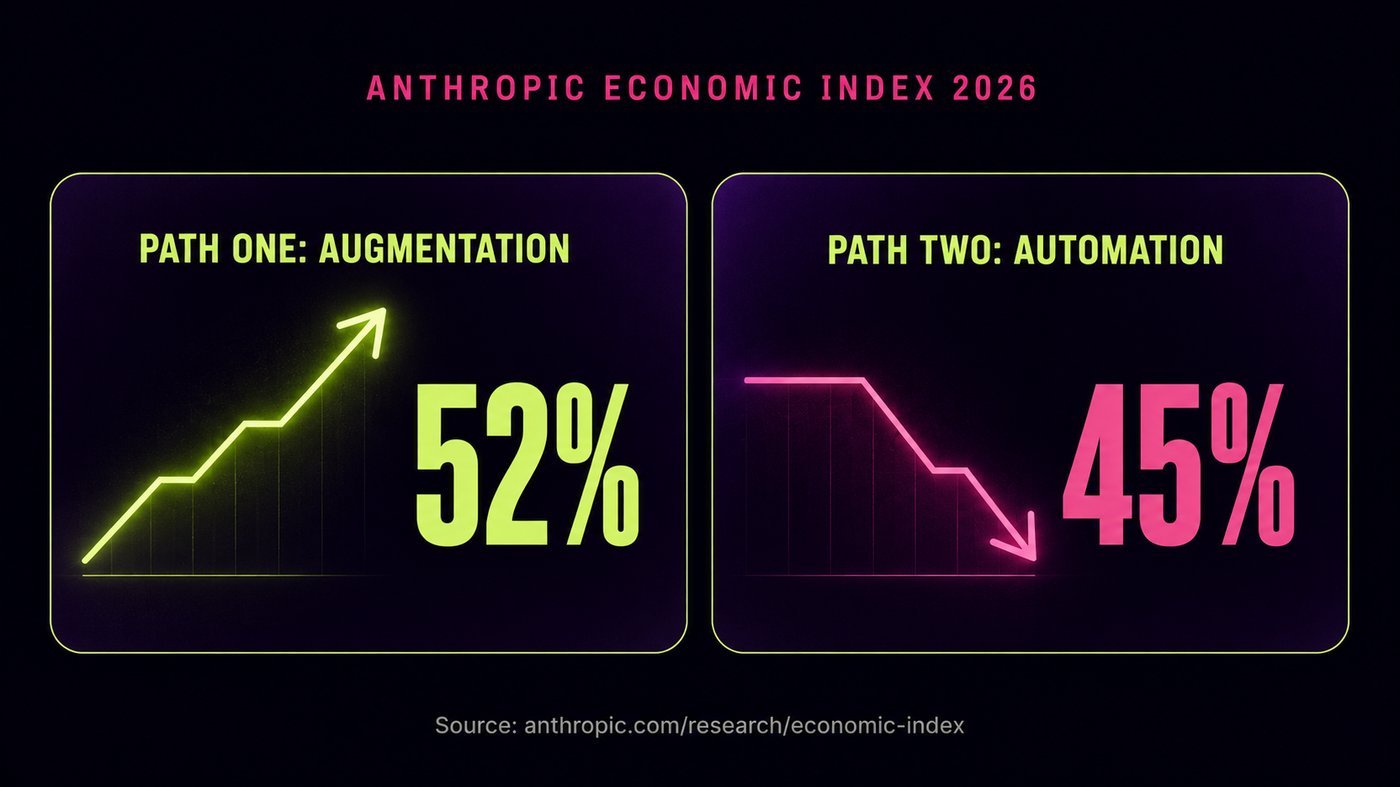
You have seen the headlines. White-collar wipeout. 40 percent of jobs gone. Goldman Sachs in 2023 estimated the equivalent of 300 million full-time jobs globally are exposed to generative AI automation. McKinsey Global Institute in 2025 estimated current AI can theoretically automate around 57 percent of US work hours, with more than 40 percent of jobs holding potential for full automation.
Read the McKinsey paper carefully. The number is technical potential, not a job-loss prediction. The authors are explicit. AI will not make most human skills obsolete. It will change how those skills are used.
But the change is not soft. The Anthropic Economic Index, published in 2025 and updated in 2026, found that augmentation (52 percent of conversations) has overtaken automation (45 percent) on Claude.ai. Translation: most knowledge workers are using AI to make themselves faster. A growing minority is using AI to do the job entirely. Both groups exist inside the same companies. They are not the same career outcome.
If you are in marketing in 2026, the relevant number is not 40 percent. The relevant number is two. There are exactly two career paths from here.
Path one. You become an augmentation marketer. AI doubles your output. You ship more, faster, with the same headcount. Your value goes up.
Path two. You become an automation casualty. The agent next to you (or above you) does what you did. Your value goes down.
Which path you take is not decided by your job title. It is decided by three patterns I will name now.
The marketers who will lose
Three patterns. Each one is enough to put you on path two by itself. Two of them together is a death sentence inside three quarters.
Pattern 1: They treat AI as a tool, not a colleague
Tools are operated. Colleagues are managed. The marketer who treats Claude or GPT as a slightly faster version of Microsoft Word is on path two. They use AI for one-off prompts. They never build a workflow. They never name a recurring task and assign it to an agent.
The marketer who treats AI as a colleague does the opposite. They write the brief. They define what good looks like. They build the loop. They review the output the way they would review a junior’s draft. The work compounds. The skill compounds. The output ships.
If your AI usage looks like ‘open ChatGPT, ask a question, copy the answer, close the tab,’ you are on path two. The fix is not more AI. The fix is treating one task per quarter as an agent-build, not a tool-use.
Pattern 2: They protect generic skills instead of moats
Generic copywriting is over as a moat. Generic Excel marketing reports are over. Generic basic SEO checks are over. Generic email-sequence assembly is over. Anyone with a 20-dollar AI subscription can produce average versions of all of these inside ten minutes.
What is not over: taste, narrative judgment, audience-specific voice, market-specific positioning, deep customer interviews, sharp original strategy, ownership of a single channel at a practitioner level. These are moats because they require lived experience, not training data. AI has no lived experience. It has training data.
The marketer who is still defending their generic copywriting skill in 2026 is on path two. The marketer who is doubling down on a moat (one specific audience, one specific channel, one specific craft they have personally shipped 100 times) is on path one.
Pattern 3: They ship to please their boss, not the market
This pattern existed before AI. AI just made it lethal.
The marketer who ships work because the boss asked for it, in the format the boss expects, with the language the boss uses, is now competing with an AI that ships exactly the same boss-pleasing output, faster, cheaper, twenty-four hours a day.
The marketer who ships work because the market needs it, with the rough edges the market actually wants, in the voice the audience actually trusts, is competing with nothing. AI cannot replicate market-specific signal because it does not sit in the market. The marketer does.
If your work product is interchangeable across employers because it is generic best-practice output, you are interchangeable with an agent. The fix is to anchor every piece of output in a specific market truth that nobody else can claim.
The marketers who will win
Three counter-patterns. They are not theoretical. I see them shipping in lean marketing teams across India and globally right now.
Counter-pattern 1: They build their first agent before they build their next deck
Winners are practitioners. They have personally built one or two AI agents that ship real work in their function. Not bought a subscription. Built a workflow. The bar is low. A weekly competitor scan. A monthly customer-interview synthesizer. A daily inbox triage. The skill is not the agent. The skill is having shipped one and learned what breaks.
If you cannot describe one agent you built in the last 90 days, you are not yet on path one. The fix is to build one this month. Not a roadmap. One agent.
Counter-pattern 2: They go deep on one craft and one audience
Winners pick one craft and one audience and own them at a practitioner level. Not at a manager level. Practitioner. They have personally written, shipped, and revised inside that craft 100 times or more. The depth is the moat. AI raises the floor for everyone. Depth raises the ceiling for the practitioner.
For me, the craft is brand and content for marketing leaders, and the audience is founders running lean teams in India. For someone else, it is paid acquisition for D2C beauty in Southeast Asia. For a third person, it is partnership marketing for B2B SaaS in the United States. The specifics matter. Depth in something specific beats breadth in everything.
Counter-pattern 3: They build their own distribution surface
Winners do not depend on an employer’s distribution channel. They build their own. LinkedIn. A newsletter. A podcast. A small but engaged audience that follows them across employers. Not a million followers. The right 5,000 to 50,000 who care about the specific work.
This is where I have personally bet 18 months of weekend work. LinkedIn at 10,052 followers. The newsletter is called The Operator. The podcast catalogue runs 1400+ episodes across three shows, with 2 million plus cumulative listens, IMDb 9.2, and Saregama Carvaan Channel 272 broadcast carriage on the flagship show. Distribution is the moat that survives every employer change. AI cannot take it from you. Only you can fail to build it.
The lever: build one agent yourself this month
If you read this far, you know which path you are on. The fix is the same regardless. Build one agent yourself this month. Not buy. Build.
Step 1: Pick a recurring task, not a project
The agent should ship the same kind of output every week or every day. Examples: a weekly competitor news scan. A daily content idea queue. A monthly campaign post-mortem template. A weekly editorial calendar build. Not a one-off campaign brief. The agent only earns its keep by repeating.
Step 2: Write the brief by hand
Write the brief the way you would write it for a junior teammate. What is the input. What does good look like. What does bad look like. What is the output format. Three failure modes you want flagged. The brief is the agent’s job description.
Step 3: Run it five times. Review every output.
Do not trust the agent on run one. Or run two. By run five, you will know what the agent does well, what it does poorly, and where you have to step in. Document this in two paragraphs. That document is your operator playbook for that agent.
Step 4: Build the next one
The compounding starts at agent number three. The first one teaches you how to brief. The second one teaches you how to review. The third one is when you realise you are no longer doing the work. You are running the work. That is the operator job. That is path one.
More in The AI-First Marketer series
This is the first published essay in The AI-First Marketer series. The series is the doctrine. Every essay names a pattern, gives you a moat, and ends with a move you can run this week.
Read the entry-point essay: Marketing Without a Team Is the New Normal. It explains the operator-vs-creator distinction this essay sits inside.
More essays drop weekly. Subscribe to The Operator to get them in your inbox without depending on the LinkedIn algorithm.
Real talk. The marketers I am writing for already feel this in their gut. The job has changed. The titles have not caught up. The companies have not caught up. The hiring market has not caught up. You will spend the next 18 months living in a gap between what you do and what your title says you do.
That gap is the opportunity. Use it.
My challenge to you. Pick one recurring task this week. Build one agent for it before May 31. Reply to my newsletter when you ship it.
FAQ
Will AI really replace marketers by 2027?
AI will not replace all marketers. AI will replace marketers who refused to redesign the job. The McKinsey 2025 estimate of around 40 percent of jobs holding potential for full automation describes technical potential, not certainty. The career-impact split is real. The exact percentage is not.
What is the most useful AI skill for a marketer to learn first?
Prompt design and review skill. The ability to write a clear brief, judge an output against the brief, and iterate the prompt to fix the failure mode. This skill is closer to managing a junior teammate than to writing code. Most marketers can pick it up in 30 days of daily practice.
Should I be using ChatGPT, Claude, or Gemini?
All three are good enough to start. Pick one and go deep for 90 days before you switch. The model is not the bottleneck. Your workflow design is.
Is building a personal brand really necessary for marketers in 2026?
Necessary if you want optionality. Not necessary if you are content with employer-dependent career outcomes. The marketers I see thriving have at minimum a strong LinkedIn presence, often a newsletter, sometimes a podcast. The right 5,000 to 50,000 followers in your specific niche is enough.
What is the operator-vs-creator distinction?
An operator builds the marketing function. A creator builds an audience around themselves. Lean marketing teams need operators at the top. The full essay on this is the entry-point in The AI-First Marketer series, titled Marketing Without a Team Is the New Normal.
Subscribe and read more
If this essay landed, the rest of The AI-First Marketer series will too. Subscribe to The Operator. Weekly. One theme. One CTA.
Read the previous essay: Marketing Without a Team Is the New Normal.
About me. I run a 30-person marketing organization at Bengaluru’s largest workspace operator. I have spent 12+ years across engineering, consulting, founding a consumer brand, and marketing leadership. I produced 1400+ podcast episodes across three shows. I write here about how lean marketing teams actually win in the AI era.

Leave a Reply