The number that changed how I think about marketing teams
In 2023, the average Series A startup in India was hiring its sixth marketing person. By the end of 2025, that same stage company was hiring its second.
Not because founders got cheaper. Because the work changed.
Goldman Sachs put a number on this in 2023. The equivalent of 300 million full-time jobs globally are exposed to generative AI automation. Office and administrative work sits at the top of that list. Marketing operations, content, email, analytics, paid media reporting, all of it was already on the list before most CMOs read the headline.
Two years later, in 2025, McKinsey Global Institute estimated that current AI can theoretically automate around 57 percent of US work hours, with more than 40 percent of jobs holding potential for full automation.
Those numbers describe technical potential, not certainty. But the working pattern in lean Indian startups is already clear. The five-person marketing team is not coming back.
If you are a founder running a team of three, four, or five, this essay is for you. If you are a marketer who joined a startup expecting to hire pods and pillars and channel leads, this essay is also for you. The job changed. The title did not.
What was: the era of the marketing army
From 2015 through 2022, the playbook was simple. Raise a Series A. Hire a marketing manager. The marketing manager hired a content writer, a performance marketer, a designer, a community lead, and an SEO consultant. Twelve months in, the team was eight people. Eighteen months in, the team was twelve.
That model worked because the bottleneck was throughput. You needed humans to write, design, run ads, schedule, report, optimize. Each function had its own tool. Each tool needed an operator. Headcount was the lever.
CMOs were measured on team size. VPs were promoted by org chart growth. Marketing was a department, not a function. The bigger the army, the more credible the leader.
Read that again. Team size was the credential.
What is: the era of the marketing operator
In 2026, that pattern has inverted. The marketing leader I respect most in Bengaluru runs a Series B SaaS company. Her team is four people. Two years ago her predecessor ran a team of nine. The four shipped more output last quarter than the nine did the quarter before they were laid off.
Not because the four are working harder. Because the four are operators, and the nine were not.
Here is the kicker. The lever is not AI tools. The lever is what the leader does with the time AI tools give back. That is the entire game.
The 2025 HubSpot State of Marketing report surveyed 1,200 marketers. 92 percent said AI has already changed their role. 91 percent said their teams use AI daily. But only 35 percent named content creation as the top AI use case. The rest is research, analytics, automation. The output is real. The leverage is real. The team size is collapsing because the leverage is real.
If you are still arguing about whether to hire a content writer or a junior performance marketer in 2026, you are arguing the wrong question. The right question is: what does my marketing function look like when one operator and three AI agents can do what eight humans did in 2022?
Operator vs creator: the central distinction
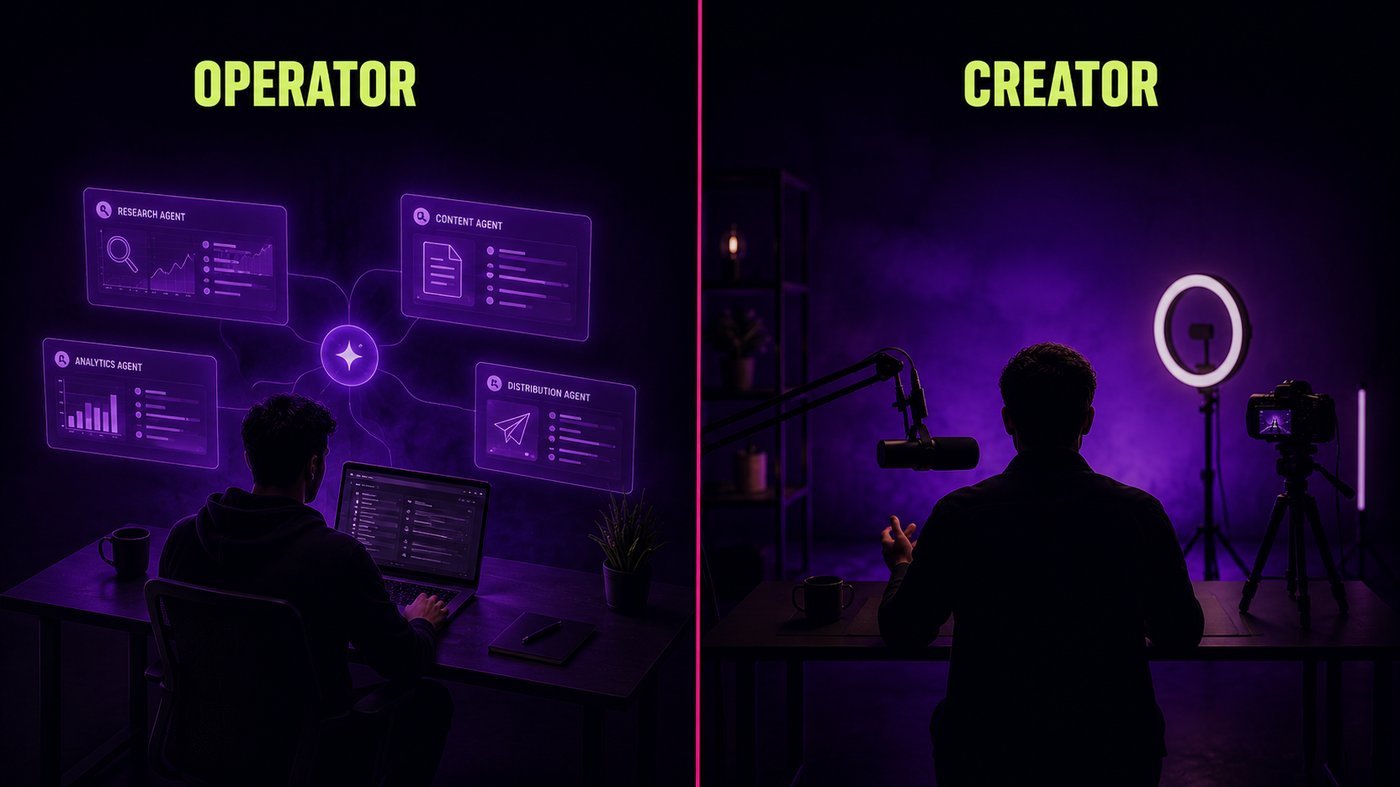
Most founders confuse these two. The confusion is expensive.
A creator is a person who writes posts, makes videos, ships carousels. They build an audience around themselves. Their unit of output is content.
An operator is a person who builds the marketing function. They design the system. They hire the agents (AI or human). They route the work. Their unit of output is throughput against pipeline.
Both are valuable. They are not the same job.
In 2026, every lean marketing team needs an operator at the top. Not a creator. Not a manager. An operator.
What an operator actually does
An operator at a lean startup runs five jobs at once.
Owns the marketing system. Tools, agents, workflows, handoffs, dashboards. The system is the team.
Owns the demand-gen ledger. Pipeline created. Pipeline influenced. Cost per qualified meeting. Nothing is vanity.
Owns the brand voice. The one thing AI cannot generate from a brief is taste. The operator is the taste filter.
Owns the founder’s calendar of public moves. Speaking, podcasts, partnerships, press. The CEO’s distribution surface is part of marketing.
Owns one craft deeply. Either content, or paid, or partnerships, or product marketing. One. Not all five. The other four are operated through agents and contractors.
What a creator does instead
A creator builds a personal audience. They write, they post, they ship. Their audience travels with them. Their unit of leverage is reach.
A creator on a marketing team is a contractor or a senior individual contributor. Not the function head. The function head is the operator.
If you mix these roles, you get what most lean Indian startups are getting in 2026. A content-writer-promoted-to-head-of-marketing who cannot read an attribution dashboard. Or a performance-marketer-promoted-to-head-of-marketing who cannot edit a piece of copy. Both end up overwhelmed inside six months. The function does not run.
Seven moves a founder or lean marketer can make this week
Pick three. Not all seven. Three.
1. Audit your marketing org against the operator job description
Print the five jobs above. Mark which ones are owned by a named human. Mark which ones are floating. The floating ones are your weak edges. They are also your AI-agent insertion points.
2. Replace your weakest reporting cadence with an AI workflow
Most lean teams have a weekly performance report that takes three hours to assemble and nobody reads. That report is the easiest agent to build. Pick one tool that ingests your channel data, one prompt that names what good looks like, one delivery format. Build it. Save the three hours. Use the three hours for the next move.
3. Move one head from human to agent
If you have a content writer producing four short posts a week, you do not need a content writer. You need an editor with an agent. The output goes up. The cost goes down. The editor is the operator’s check on quality. This is not a layoff move. This is a redesign move. If the writer is operator material, train them up. If they are not, they were going to plateau anyway.
4. Pick one craft and go deep
Pick the one part of marketing you will personally master. For me, it is brand and content. For someone else, it is paid acquisition. For a third person, it is partnerships. Whatever it is, the operator owns one craft as a practitioner, not just a manager. The craft is your moat against being commoditized by your own AI stack.
5. Build your own personal distribution surface
If you run marketing for a company, you are also a public-facing professional. LinkedIn at minimum. A podcast guesting cadence. A newsletter if you have the discipline. The operator’s brand is the company’s recruiting magnet, partnership magnet, and credibility magnet. You do not need a million followers. You need the right 5,000 to know who you are.
6. Kill one dashboard
Every lean marketing team has at least one dashboard nobody opens. Kill it. Replace it with a Friday two-paragraph note from the operator. Numbers, narrative, decision. That is the report. That is the only report.
7. Pick one company you watch
Find one lean marketing team three steps ahead of you. Study their public moves for one quarter. Steal what is stealable. Skip what is not. The fastest way to get better is to study an operator who has already shipped what you are about to ship.
Where this fits in The AI-First Marketer series
This essay is the entry point. The promise on the homepage is simple. Marketing without a team is the new normal. I write about how to actually do it.
The next essay in the series is sharper. It is called Why Most Marketers Will Lose to AI. It names the three patterns that separate the marketers who survive from the marketers who do not. If this essay was the diagnosis, that one is the warning.
Read it next. Then come back here. Pick three of the seven moves. Run them this week.
Real talk. The operator path is harder than the creator path. It pays better in the long run, but the daily work is more boring. You will spend more time editing prompts than writing posts. You will spend more time building dashboards than presenting them. You will spend more time on system design than on visible output.
That is the trade.
If you want a manager job at a 2018 startup, that job does not exist anymore. If you want an operator job at a 2026 startup, this is the playbook.
My challenge to you. Pick the move that scares you most. Run it this week. Reply to my newsletter and tell me what broke.
FAQ
What does ‘marketing without a team’ actually mean?
Marketing without a team means running a marketing function with two to five humans plus an AI agent stack, instead of the eight-to-twelve person team that was standard in Indian startups from 2018 through 2022. The function still exists. The headcount has collapsed. The leverage has moved to AI workflows and operator judgment.
Is this only for early-stage founders?
No. The pattern shows up in three places. Pre-Series-A founders running marketing themselves. Lean Series A and B teams of three to six people. And mid-stage marketing leaders managing through reorgs. The principles are the same. Operator over creator. System over headcount.
What is the operator-vs-creator distinction in one sentence?
A creator’s unit of output is content. An operator’s unit of output is throughput against pipeline. Lean marketing teams need operators at the top, not creators.
Do I need to be technical to be a marketing operator in 2026?
You need to be comfortable with prompt design, basic automation logic, and reading dashboards. You do not need to write code. The bar is closer to a power-user of business software than to an engineer. Most marketers cross this bar inside ninety days if they commit.
Where do I start if my team is currently five people and overwhelmed?
Start with move number two. Replace your weakest reporting cadence with an AI workflow. Save three hours. Use those three hours to run move number one, the audit. Once the audit is done, you will know which of the next moves matters most for your specific function.
Subscribe and read more
If this essay landed, the rest of The AI-First Marketer series will too. The newsletter is free. It is called The Operator. Weekly. One theme. One CTA. No fluff.
Read the next essay in the series: Why Most Marketers Will Lose to AI.
About me. I run a 30-person marketing organization at Bengaluru’s largest workspace operator. I have spent 12+ years across engineering, consulting, founding a consumer brand, and marketing leadership. I produced 1400+ podcast episodes across three shows. I write here about how lean marketing teams actually win in the AI era.

Leave a Reply